
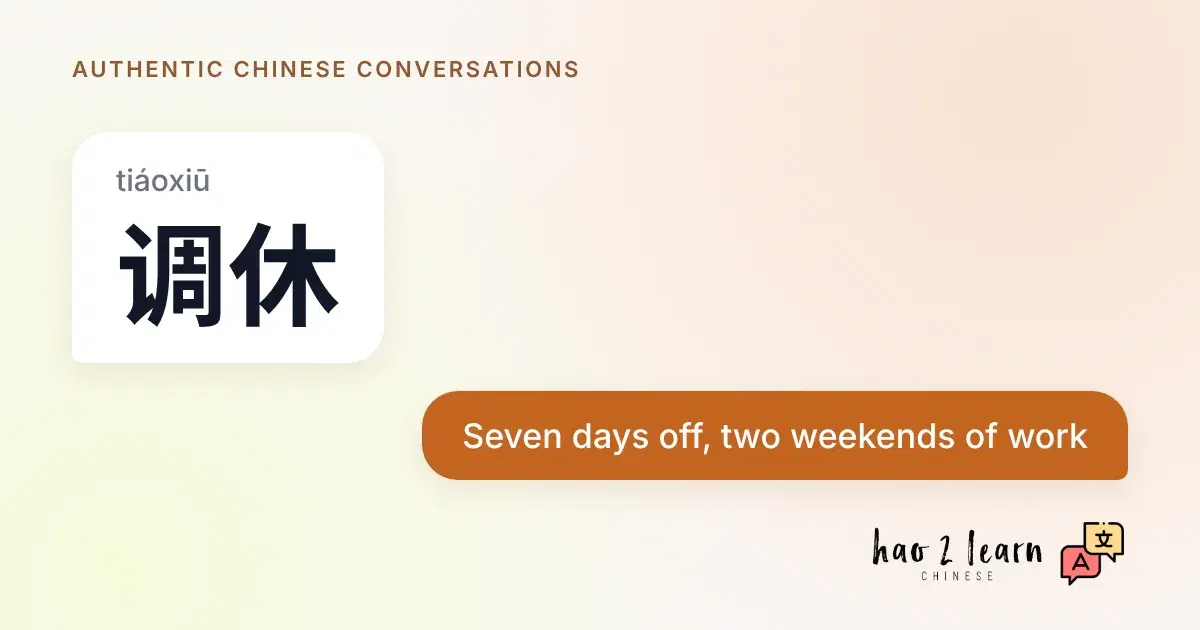
调休: why a Chinese holiday week comes with weekend work
China’s week-long holidays are partly paid back with weekend workdays. That swap is called 调休, and every year people have this exact conversation about it, ending with 我就知道.
Yumi
· 6 min read
Tap any word for pinyin and meaning.
Two coworkers, waiting for the official October holiday schedule.
The conversation
What makes it sound real
What 调休 is
China’s public holidays are only a few days long on paper. To turn them into a full week off, weekends around the holiday are swapped: a Saturday or Sunday becomes a workday, and the weekdays in between become days off. That swap is 调休, from 调 (adjust) and 休 (rest). The schedule is announced every year, and every year people grumble about it.
Day | In this conversation |
|---|---|
节前那个周日 (the Sunday before) | 上班, work |
10月1日 – 7日 | 放假, seven days off |
节后那个周六 (the Saturday after) | 上班, work |
出来了: it’s out
出来 is “come out”, and it’s used for anything that gets announced or published: 成绩出来了 (the grades are out), 调休安排出来了 (the holiday schedule is out). In class you mostly meet it as movement, like 他从房间里出来了.
节前, 节后
节 is short for 节日, holiday. 节前 and 节后 mean “before the holiday” and “after the holiday”, and you’ll hear them constantly in the weeks around Chinese New Year and October.
节前很忙,节后再联系吧。 (Things are busy before the holiday, let’s talk after.)
对 after a negative question
A asks 节前不用多上一天?, “we don’t have to work an extra day before?”. B starts with 对, which agrees with the question as it was asked: “right, we don’t.” In English you’d say “no” to mean the same thing. Then she remembers, and the answer flips.
我就知道
“I knew it.” 就 adds “exactly as expected”, and the tone is resigned, not proud. It’s the natural reply to bad news you saw coming.
What is 调休?
Teaching Chinese? Build an interactive text like this one in the hao2learn editor.
Keep reading
- 随便: the hardest answer to “what do you want to eat?”Ask a Chinese friend what they want to eat and you’ll often hear 随便, “whatever”. A ten-line dialogue that shows what 随便 really means, with 不然, 行 and 算了 along the way.5 November 2026
- 没人管我: a quiet week at work, in ChineseA four-line chat about overtime between two friends. 比较 that compares nothing, 怎么回事 instead of 为什么, and the real reason the week was so quiet.25 October 2026
- Booking a trip in Chinese: 订好了吗, 赶紧 and 新马泰Two friends talk about hotel prices and visas before a trip to Singapore. Everyday Chinese like 赶紧, 晚点更贵 and 还好, plus 新马泰, a word that comes from package tours.16 October 2026
- 懒得出去了: saying you’d rather stay home in ChineseNot everyone travels over the October holiday. A four-line dialogue with 懒得, 好不容易 and 多浪费啊, the kind of Chinese you hear from friends rather than in class.28 September 2026