
Navigating the metro in Chinese
Six phrases cover almost every set of metro directions in China: which line, which direction, how many stops, where to change. With Shanghai examples, audio, and what the announcements say.
Bastian
· 16 min read
Tap any word for pinyin and meaning.
Taking the metro in China is easy. Being told how to take it is harder: someone rattles off a line number, a direction, a number of stops and a transfer in one breath, and you nod and hope for the best. The good news is that nearly every set of directions is built from the same six pieces. Here they are, with examples from the Shanghai Metro.
Six phrases that do all the work
坐二号线: take Line 2
Lines are numbered: 一号线, 二号线, 十号线. 号 is “number” and 线 is “line”. The verb is 坐, the same word as “to sit”, even though at rush hour you won’t.
One trap: Line 2 is 二号线, never 两号线. When you count stops it flips around, and two stops is 两站, never 二站.
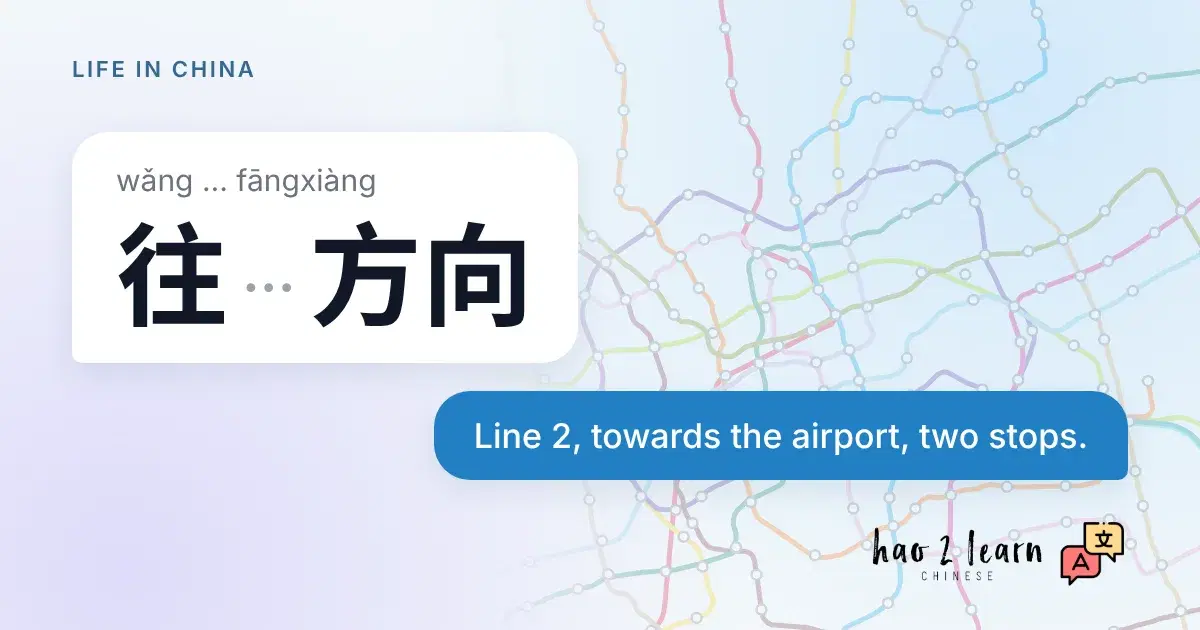
往浦东国际机场方向: towards Pudong Airport
Every line runs in two directions, and each direction is named after the station at the end of the line. 往 means “towards”, 方向 means “direction”, and the station goes in between. The signs on the platform use exactly the same words, so this is the phrase that saves you from riding forty minutes the wrong way.
Line 4 is the exception. It’s a loop with no last station, so its directions are 内圈 (inner loop) and 外圈 (outer loop).
坐三站: ride three stops
站 is both “station” and “stop”. 坐三站 is “ride three stops”, 坐到人民广场 is “ride to People’s Square”, and 第三站 is “the third stop”. People giving directions often say both the count and the name: 坐三站,到人民广场。
在人民广场换八号线: change to Line 8 at People’s Square
换 is “to change”. Signs and announcements use the more formal 换乘 (transfer), but in conversation people just say 换. The pattern is always the same: 在 + station + 换 + line.
在陆家嘴下车: get off at Lujiazui
下车 is “to get off” and 上车 is “to get on”. After that, 出站 means leaving the station. Exits are numbered, so 二号口 is Exit 2, and it’s usually the last thing a friend tells you: 从二号口出来,我在门口等你。
别坐反了: don’t go the wrong way
Real directions come with warnings, and 别 (don’t) does most of that work: 别坐反了 (don’t ride the wrong way), 不是莘庄方向 (not towards Xinzhuang), 千万别在老西门下 (whatever you do, don’t get off at Laoximen). Listen out for these. They are often the most useful part of the sentence.
Here are all six, read slowly and each said twice, with time to repeat after the speaker:
Phrase | Meaning |
|---|---|
坐 X 号线 | take Line X |
往 X 方向 | towards X |
坐 X 站 / 坐到 X | ride X stops / ride to X |
在 X 换 Y 号线 | change to Line Y at X |
在 X 下车 | get off at X |
出站 · X 号口 | leave the station · Exit X |
别坐反了 | don’t go the wrong way |
A sign on a Line 1 platform says 往莘庄方向. What does it tell you?
Putting it together
This is the kind of exchange you’ll have with station staff or a stranger on the platform. Someone at Jing’an Temple wants to get to Xintiandi:
Notice how the traveller repeats each piece back: 往张江路方向,两站. That isn’t rude, it’s normal, and it’s the fastest way to catch a mistake. The 就 in 一站就换 means “already, so soon”. And the station’s official name is 一大会址·新天地, which nobody says out loud.
What the train tells you
On the Shanghai Metro, announcements come in Mandarin and English. Lines 16 and 17, which run far out into the suburbs, add Shanghainese as well. The exact wording changes a little from line to line, but these are the lines you’ll hear and read most:
You hear or read | It means |
|---|---|
下一站,人民广场 | next station: People’s Square |
可换乘一号线、八号线 | transfer here for Lines 1 and 8 |
本次列车终点站…… | this train terminates at … |
请注意列车与站台之间的空隙 | mind the gap between the train and the platform |
请勿倚靠车门 | don’t lean on the doors |
Here is our own re-recording of two typical announcements. It’s not the real metro voice, but it’s close:
Watch out for 本次列车终点站. On some longer lines, not every train runs to the end. The screen and the announcement tell you where this train actually stops for good. If your station is beyond that, wait for the next one.
When nobody says the number
People who can’t remember a line number describe it instead, by its colour (红色那条, “the red one”) or by where it goes (去迪士尼那条, “the one to Disneyland”).
How do you say “ride two stops”?
Now try it with your ears
Reading these phrases is one thing. Catching them at full speed is another. In our Shanghai Metro listening game you start at a real station on the real map, listen to someone describe a route, and find the station where you end up. Level one is a slow teacher. Level ten is a rushed phone call across three lines, with a friend who changes his mind halfway through.
And finally, don't forget: On the escalator down to the subway, 你不要看手机!
Teaching Chinese? Build an interactive text like this one in the hao2learn editor.
Keep reading
- 随便: the hardest answer to “what do you want to eat?”Ask a Chinese friend what they want to eat and you’ll often hear 随便, “whatever”. A ten-line dialogue that shows what 随便 really means, with 不然, 行 and 算了 along the way.5 November 2026
- 没人管我: a quiet week at work, in ChineseA four-line chat about overtime between two friends. 比较 that compares nothing, 怎么回事 instead of 为什么, and the real reason the week was so quiet.25 October 2026
- Booking a trip in Chinese: 订好了吗, 赶紧 and 新马泰Two friends talk about hotel prices and visas before a trip to Singapore. Everyday Chinese like 赶紧, 晚点更贵 and 还好, plus 新马泰, a word that comes from package tours.16 October 2026
- 懒得出去了: saying you’d rather stay home in ChineseNot everyone travels over the October holiday. A four-line dialogue with 懒得, 好不容易 and 多浪费啊, the kind of Chinese you hear from friends rather than in class.28 September 2026