
Talking about holiday plans in Chinese: 十一 and 自驾游
Two colleagues talk about their October holiday. Why 十一 means a week off rather than the number eleven, and why a 自驾游 to Xinjiang usually starts at the airport.
Yumi
· 5 min read
Tap any word for pinyin and meaning.
Two colleagues, a couple of weeks before the October holiday.
The conversation
What makes it sound real
十一 is a holiday, not a number
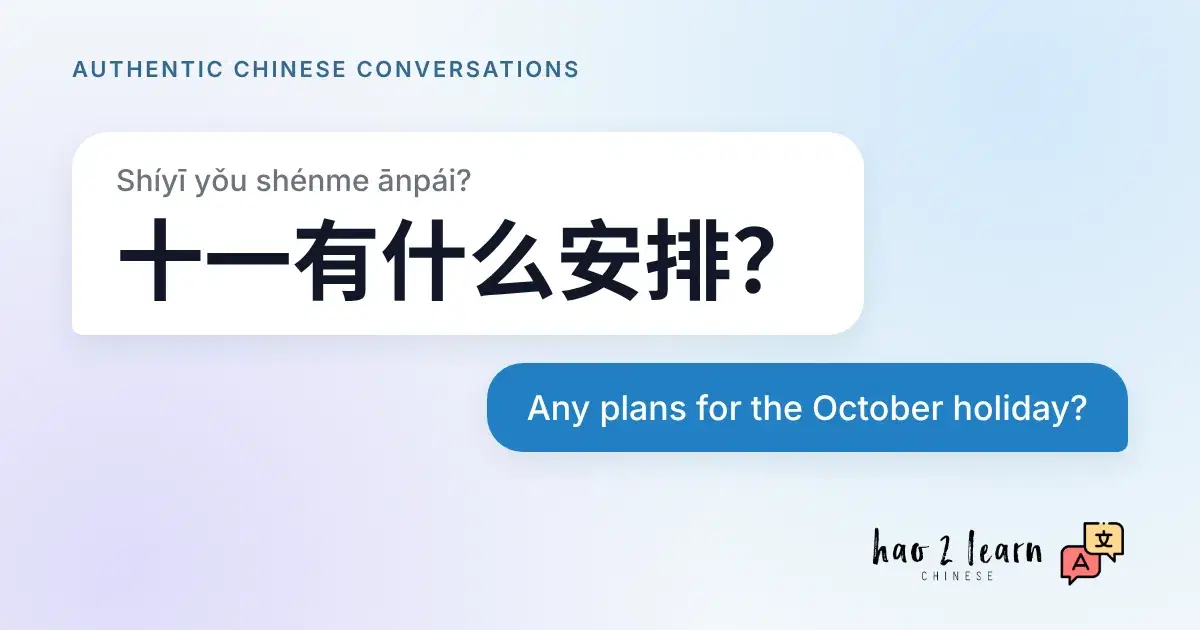
十一 means “eleven”, but here it means October 1st, China’s National Day, and the week off that comes with it. Holidays are often named after their dates: 五一 is the May Day break, 十一 is the October one. The textbook word is 国庆节. At work and among friends, people just say 十一.
你十一回家吗? (Are you going home for the October holiday?)
五一人太多了,哪儿都不想去。 (Everywhere is packed over May Day, I don’t want to go anywhere.)
自驾游 doesn’t mean driving from home
A 自驾游 is a trip where you drive yourself around a region instead of joining a tour group. It says nothing about how you get there. Xinjiang is almost 3,000 km from Beijing by road, so most people fly to 乌鲁木齐 (Ürümqi) and rent a car. That’s why the question is whether B drives all the way or flies first and rents.
Textbook | What people say |
|---|---|
开车去新疆旅游 | 去新疆自驾游 |
坐飞机去 | 飞过去 |
飞过去, 开车过去
Classes teach 坐飞机去, “take a plane to go”. In conversation the way of travelling goes in front of 过去, “over there”: 飞过去, 开车过去, 坐高铁过去. 飞 on its own is enough. For coming towards the speaker it’s 过来: 你怎么过来? (How are you getting here?)
不然太累了
不然 means “otherwise”, and it lets B skip half the sentence. The full thought would be “if I drove all the way, it would be too tiring”. 不然 points back at the option she isn’t taking, and 太…了 finishes the complaint.
In this conversation, what does 十一 refer to?
Teaching Chinese? Build an interactive text like this one in the hao2learn editor.
Keep reading
- 随便: the hardest answer to “what do you want to eat?”Ask a Chinese friend what they want to eat and you’ll often hear 随便, “whatever”. A ten-line dialogue that shows what 随便 really means, with 不然, 行 and 算了 along the way.5 November 2026
- 没人管我: a quiet week at work, in ChineseA four-line chat about overtime between two friends. 比较 that compares nothing, 怎么回事 instead of 为什么, and the real reason the week was so quiet.25 October 2026
- Booking a trip in Chinese: 订好了吗, 赶紧 and 新马泰Two friends talk about hotel prices and visas before a trip to Singapore. Everyday Chinese like 赶紧, 晚点更贵 and 还好, plus 新马泰, a word that comes from package tours.16 October 2026
- 懒得出去了: saying you’d rather stay home in ChineseNot everyone travels over the October holiday. A four-line dialogue with 懒得, 好不容易 and 多浪费啊, the kind of Chinese you hear from friends rather than in class.28 September 2026